Governance
Your engineering standards,enforced at merge.
Engineering rules stop living in documents and good intentions. Brunelly evaluates them, deterministically, against the exact commit that would merge, records every decision, and makes exceptions accountable.
Merge policy
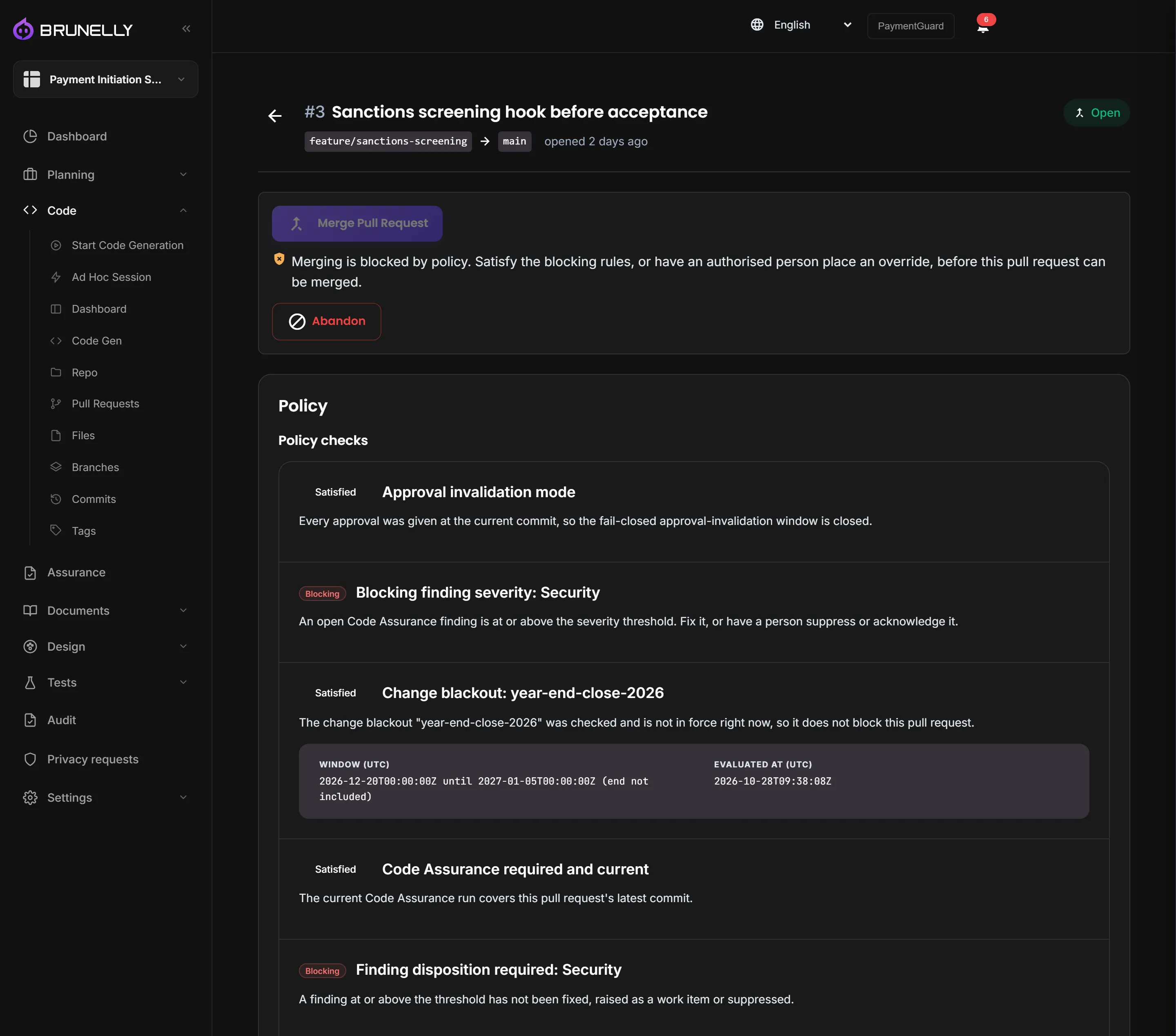
Two rules unmet. The merge is blocked.
Every merge is decided against the precise revision that would land. If the branch moves, the decision is taken again. On GitHub and Azure DevOps the same rules hold for pull requests opened anywhere, not only those Brunelly created.
at f519425- ✓Code Assurance present and current at headMet
- ✓No undispositioned finding at medium or aboveMet
- ✕Two human reviewers, one a code owner1 of 2 approvalsNot met
- ✓Separation of duties: author cannot approveMet
- ✕Release freeze on release/**Freeze active until 4 NovNot met
Org rule · pinnedPolicy model
Central control, local flexibility.
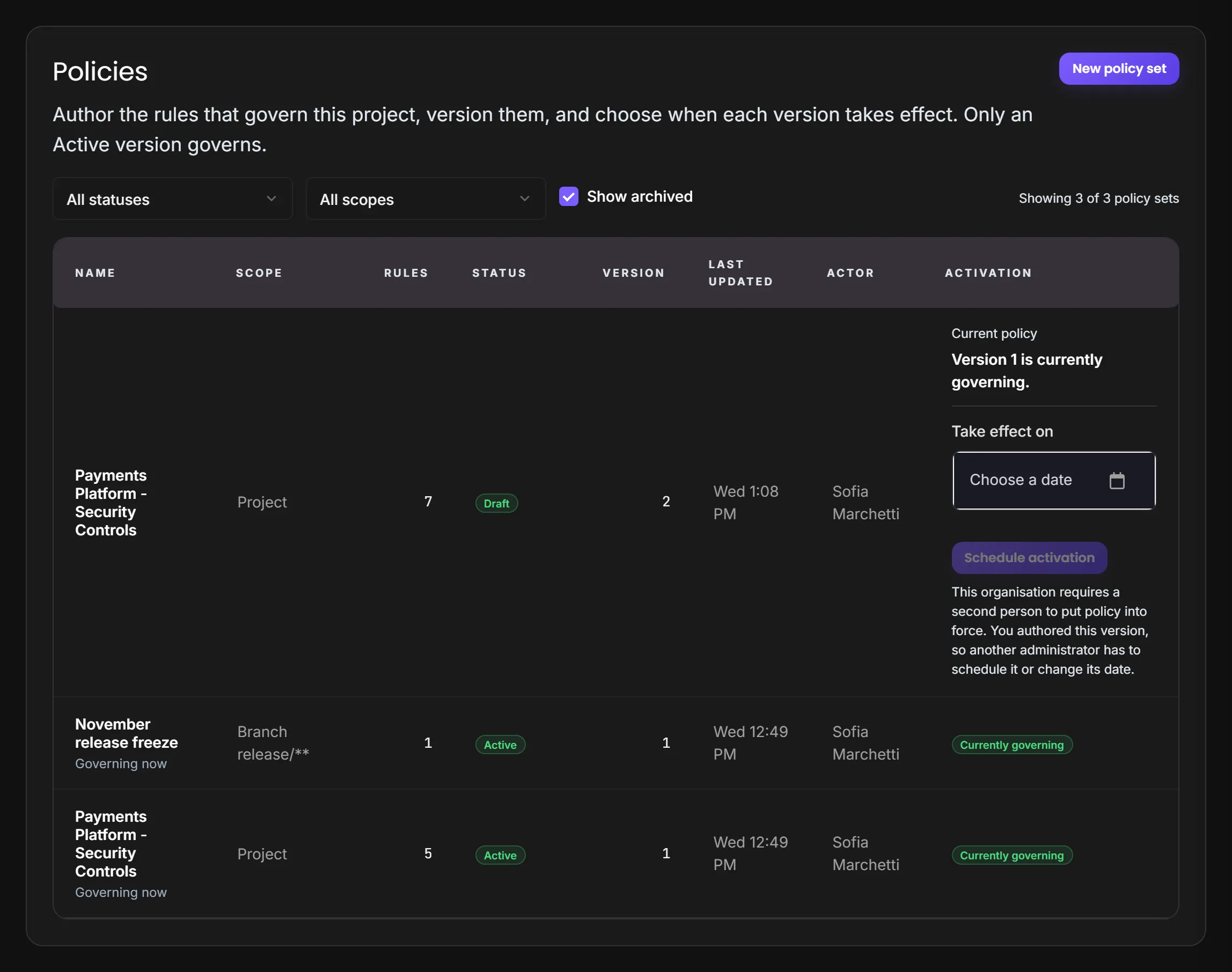
Policies stack from the organisation down to a branch pattern. The organisation decides what is fixed; projects adapt the rest.
- 01Pinned rules cannot be weakened
Organisation
Central rules for every project. Pin the ones that must never move.
- 02Adapts unpinned rules
Project
Rules for one product or team, adapting what the organisation leaves unpinned.
- 03Targets matching branches
Branch pattern
Stricter rules where it counts, such as release/** during a freeze.
How it holds
Rules that apply whoever writes the code.
- 01
Policies at every level
Define rules for the whole organisation, for a project, or for branches that match a pattern. Pin a central rule and no project can weaken or disable it; leave it unpinned and teams can adapt it locally.
- 02
Evaluated at the exact commit
Every merge is decided against the precise revision that would land: required assurance present and current, findings within threshold, the reviewers you require, separation of duties and release freezes. If the branch moves, the decision is taken again.
- 03
Findings are dispositioned, not hidden
Every finding ends one of three ways: fixed and gone from the head commit, raised as tracked work, or suppressed under a stated reason and expiry. Hiding a finding from view is not a disposition.
- 04
Governed exceptions
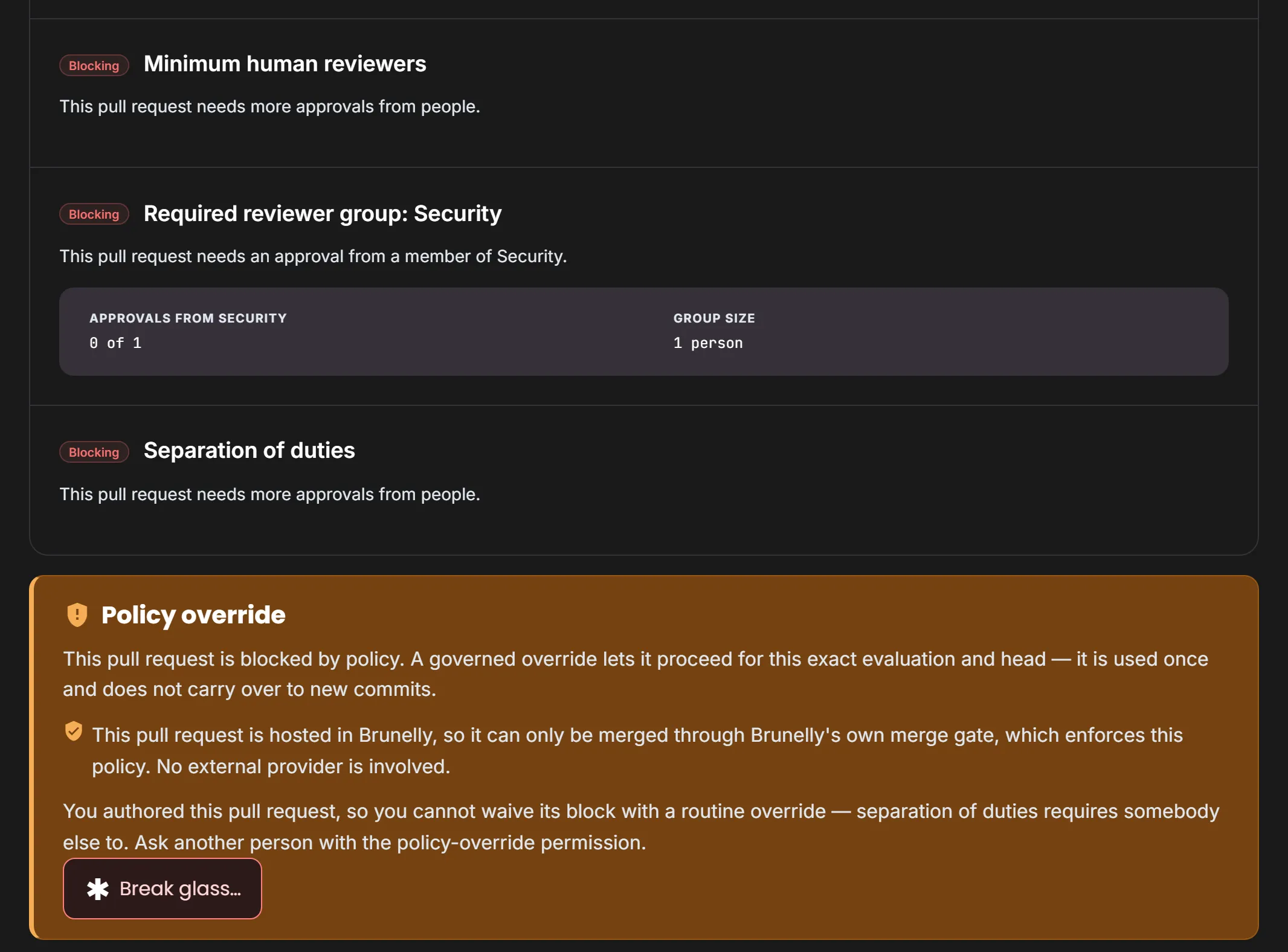
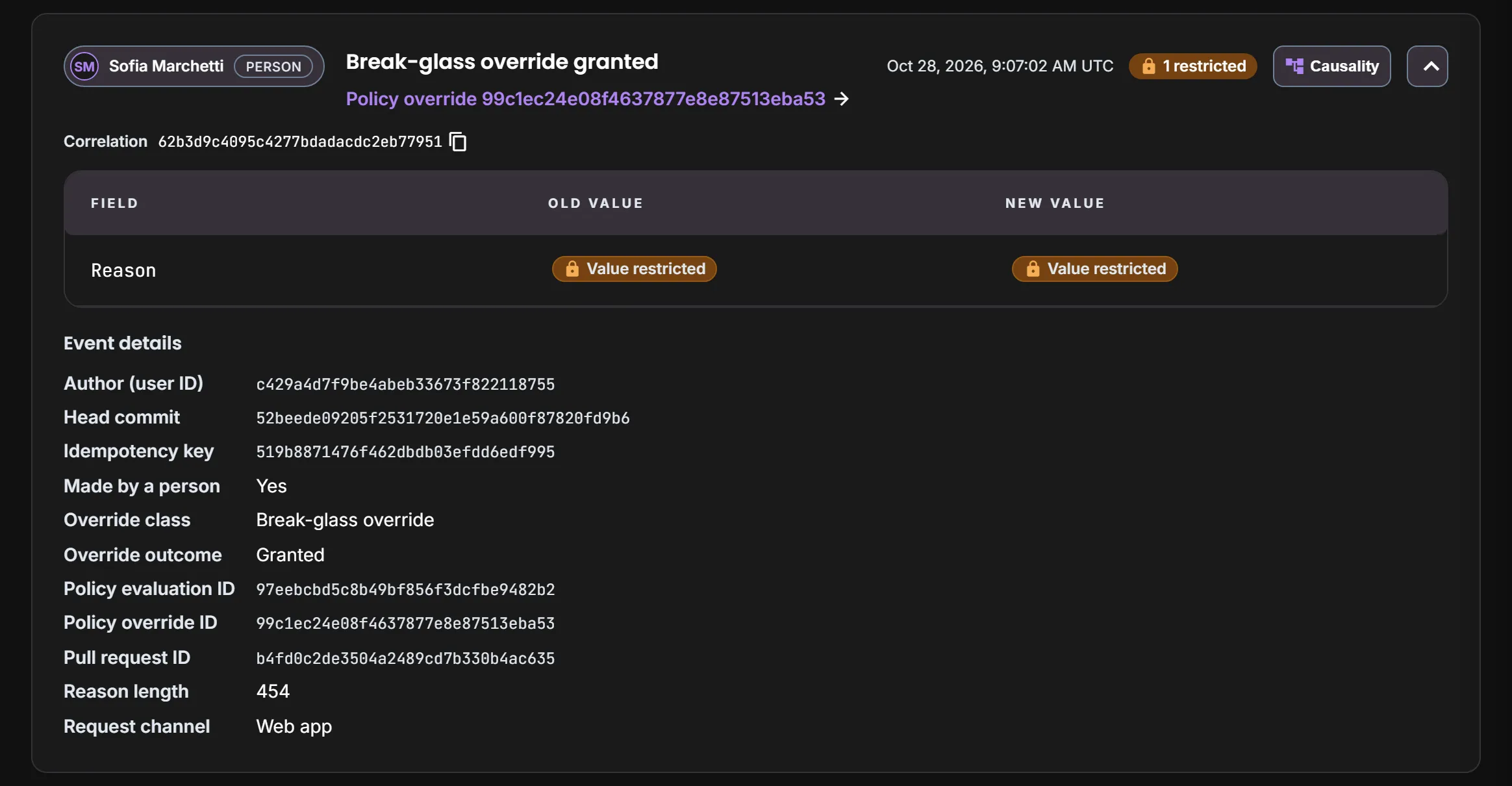
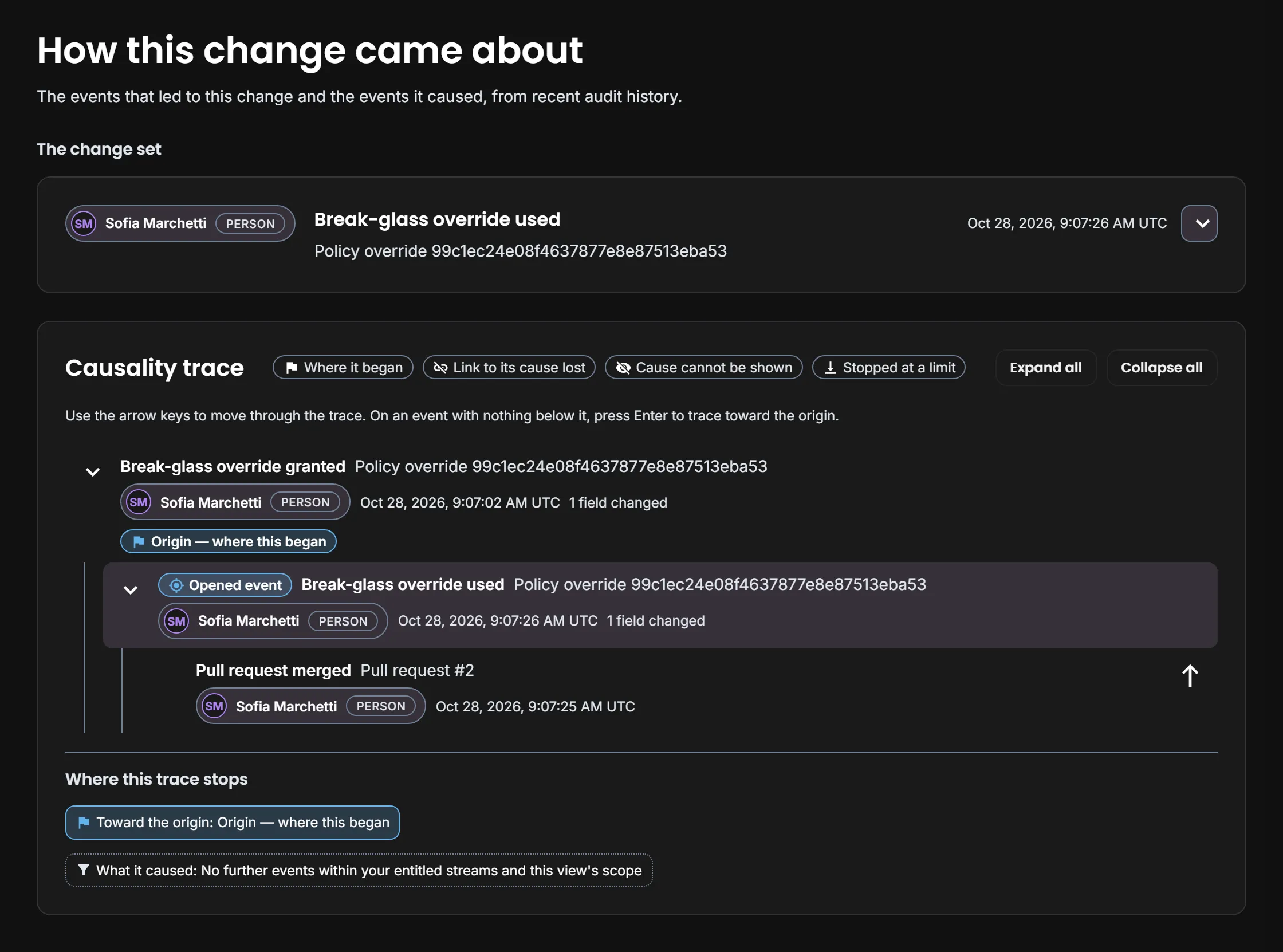
Overrides need the right permission and a written reason, and are recorded. For emergencies, break-glass is a separate, single-use grant bound to one evaluation and one commit, so it can never be reused on anything else.
- 05
Policy as code
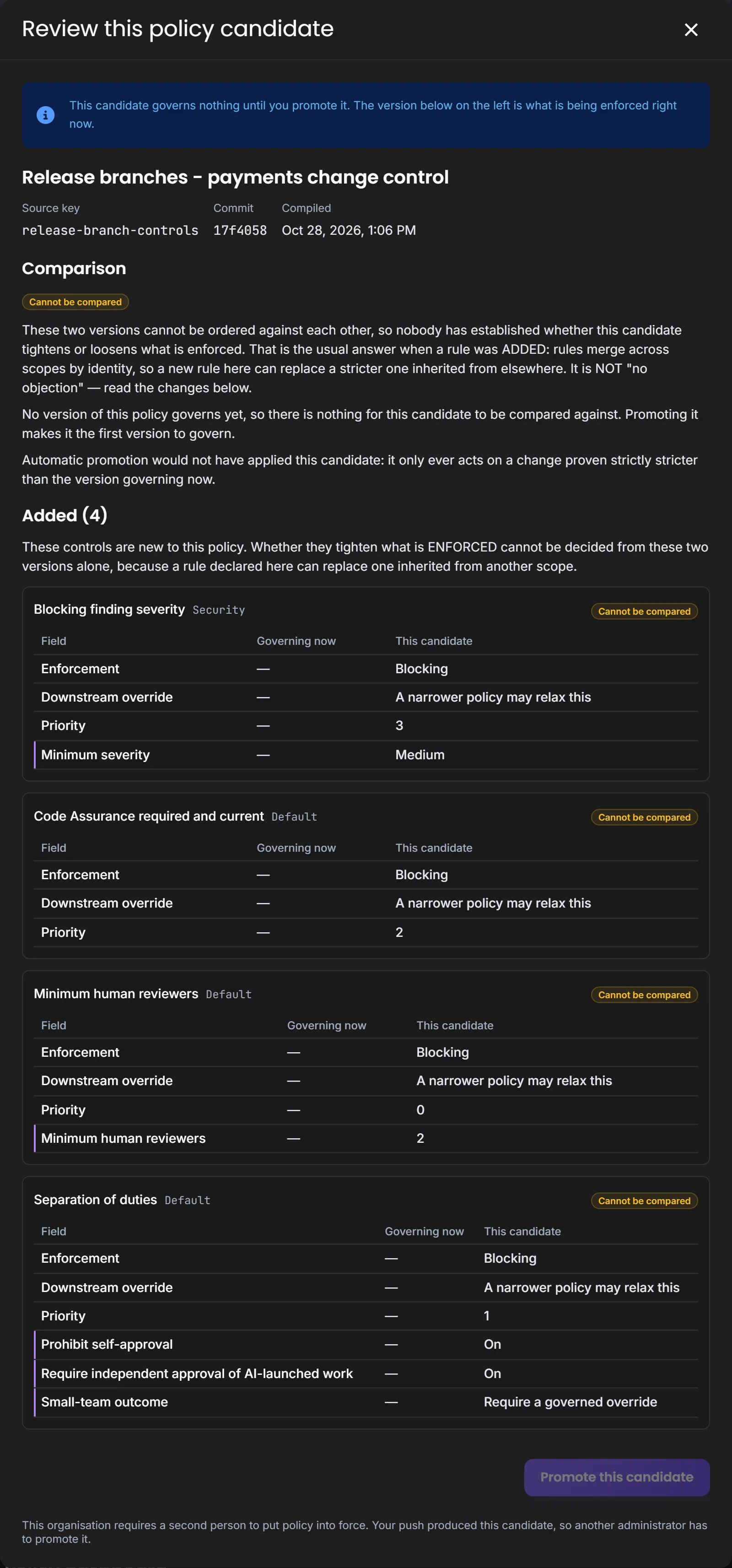
Keep policies in your repository as YAML, with the repository, commit and content hash recorded on every version. Simulate a change against recorded decisions before you enforce it, and let a new version promote itself only when it is provably stricter.
- 06
Enforced in your repositories
On GitHub and Azure DevOps, Brunelly configures a required check on the default branch and verifies the platform applied it, so the rules hold for pull requests opened anywhere, not only those Brunelly created. A drift sweep reports any rule someone removes.
- 07
Tamper-evident audit
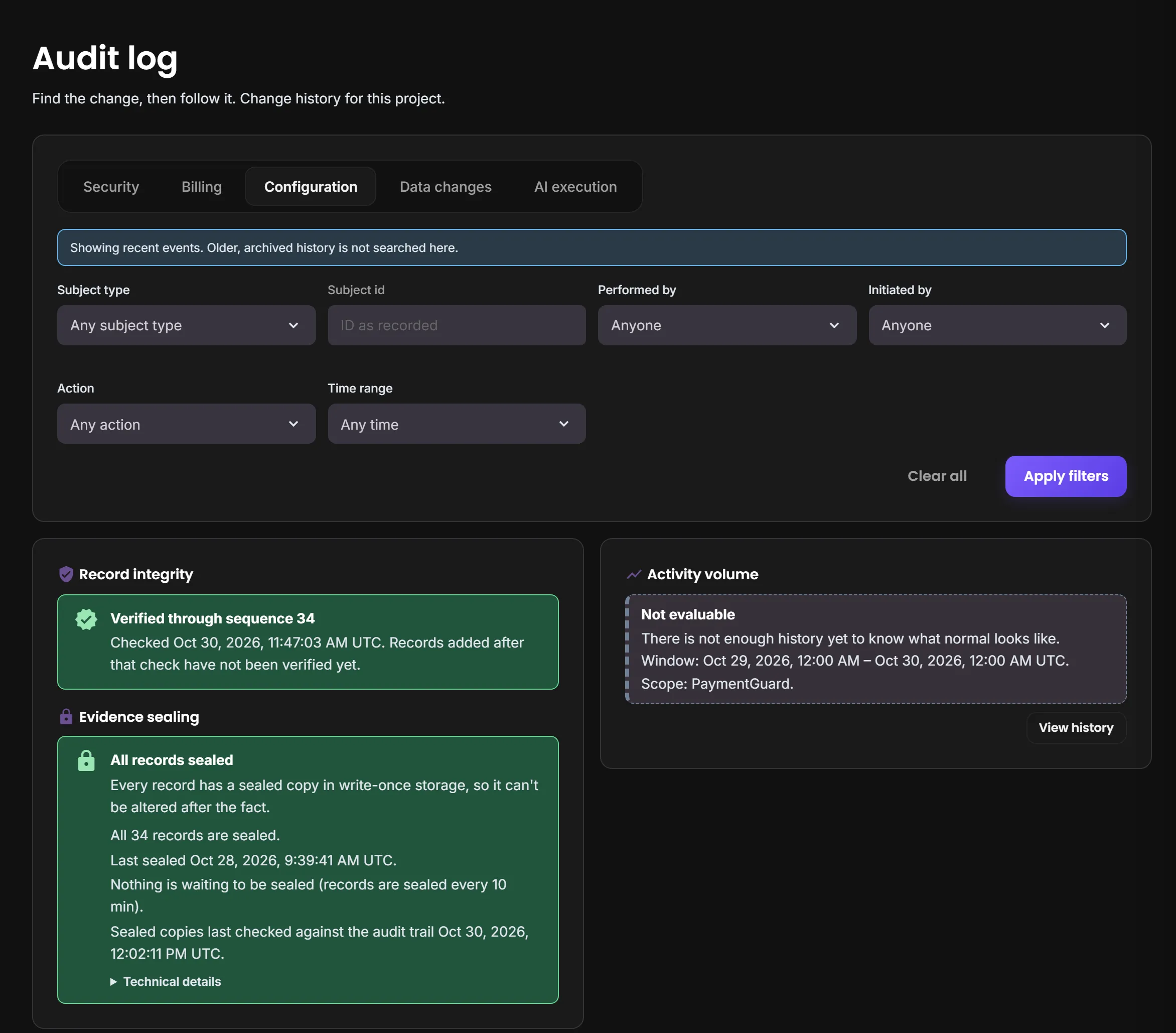
Policy decisions, approvals, overrides and rule changes are written to a hash-chained trail per tenant, verified every fifteen minutes and in full weekly, and sealed with signed anchors in write-once storage.
- 08
Evidence you can verify yourself
Export a signed evidence pack for an auditor or a regulator, with a standalone verifier that checks it offline, without access to Brunelly.
- 09
Keys per tenant, erasure by design
Data is protected by a key hierarchy rooted in HSM-backed keys, with keys per tenant and per subject. Erasing a person destroys their key, so their audit records become unreadable while the chain around them still verifies.
Exceptions
When the rule has to bend, it bends on the record.
Real delivery needs exceptions. Brunelly gives them a shape, an owner and a trail.
A reasoned exception to one rule
- Needs the override permission
- A written reason, captured with the decision
- Recorded in the audit trail
An emergency that cannot wait
- A separate grant, for people only
- Single use, bound to one evaluation and one commit
- A written reason, always
- Written to the audit trail as a mandatory record
Evidence
A trail that proves itself.
Every governance decision is chained to the one before it, verified continuously and sealed in write-once storage. Export it for an auditor, with a verifier that runs offline, without trusting Brunelly.
- Hash-chained per tenant, verified every fifteen minutes
- Sealed with signed anchors in write-once storage
- Evidence packs an auditor can verify offline
9f2c…e41a1b7d…08c2c3e9…5f176a40…d9b3Policies at merge
0:28Your rules, evaluated at the exact commit
Human approvals and separation of duties enforced, an override with a named person and a written reason, and the record.
The product
Governance, in the product
Every plan, review, decision and exception is on the record, and on screen.
Keep exploring
The rest of the platform.
How it works
The governed engineering process, step by step
Review panel
Blind review across models, decided by rule
Code Assurance
Six lenses on any code, including code you did not write
Planning and context
Boards, stories and what Brunelly knows about your code
Engines and integrations
Your models, repositories and trackers
Security and trust
How we protect your code, credentials and the record
Get started
Make software engineering repeatable.
Every engagement starts with a scoped pilot on one problem that matters, measured against how your team works today.